Amarican weapons
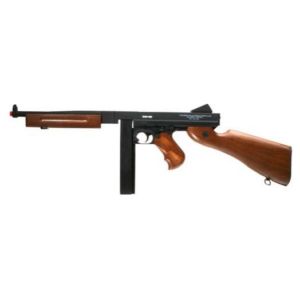
The Thompson submachine gun is an American submachine gun, invented by John T. Thompson in 1919 that became infamous during the Prohibition era. It was a common sight of the time, being used by both law enforcement officers and criminals.
The Thompson was also known informally as: the "Tommy Gun", the "Trench Broom", the "Trench Sweeper", the "Chicago Piano", the "Chicago Typewriter", and the "Chopper".
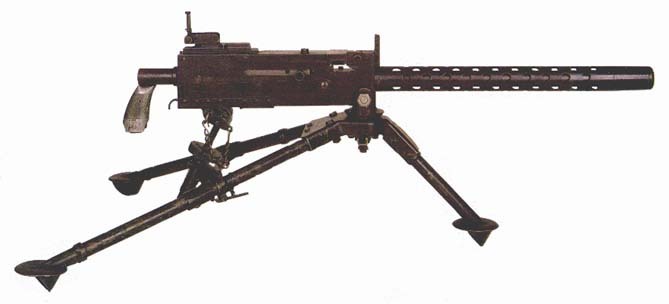
The M1919 Browning is a .30 caliber medium machine gun that was widely used during the 20th century. It was used as a light infantry, coaxial, mounted, aircraft, and anti-aircraft machine gun by the U.S. and many other countries, especially during World War II, the Korean War, and the Vietnam War. Although it began to be superseded by newer designs in the later half of the century (such as by the M60 machine gun), it remained in use in many North Atlantic Treaty Organization (NATO) countries and elsewhere for much longer. It is very similar in design to the larger
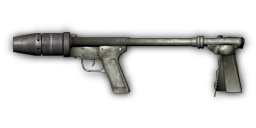
The M2 flamethrower (M2-2) was a man-portable backpack flamethrower that was used in World War II. Although its actual "burn time" was around 7 seconds and the flame was only effective out to around 33 meters, it was still a functional weapon that had many uses in the war. However, with the later arrival of tanks and, especially, flamethrower tanks, the need for infantrymen to expose themselves to fire became unnecessary as tanks offered greater protection while still delivering the effective damage.
As some were sold off, the majority of them were also scrapped when they were declared "obsolete."
Russian weapons
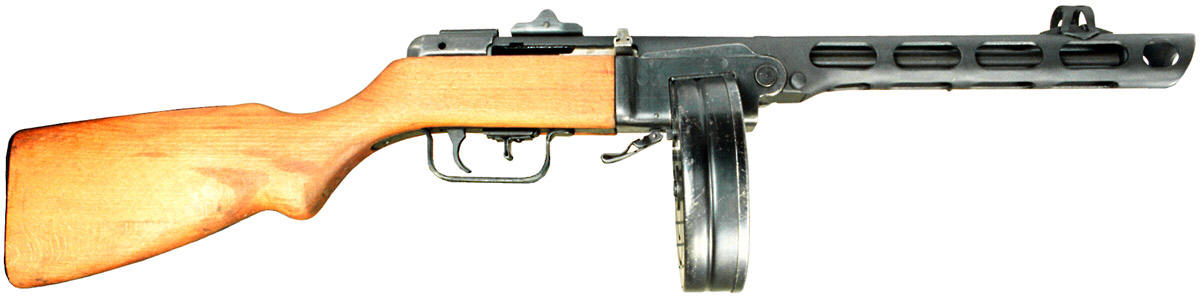
The PPSh-41 (Pistolet-Pulemyot Shpagina; Russian: Пистолет-пулемёт Шпагина; Shpagin Machine Pistol; nicknamed Pah-Pah-sha, Shpagin and Burp Gun) submachine gun was one of the most mass produced weapons of its type of World War II. It was designed by Georgi Shpagin as an inexpensive alternative to the PPD-40, which was expensive and time consuming to build. The PPSh operated with simple blowback action, had a box or drum magazine, and fired a 7.62x25mm pistol round.
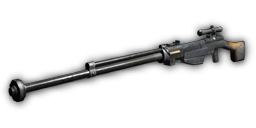
The PTRS-41 was produced and used by the Soviet Union during World War II. In the years between the World Wars, the Soviet Union began experimenting with different types of armour-piercing anti-tank cartridges. Finding the 12.7x108mm insufficient, they began development of what would become the 14.5x114mm armor piercing round. Famous Soviet weapons designers such as Vasily Degtyaryov and Sergei Gavrilovich Simonov designed rifles to accommodate this cartridge. In 1938, Simonov designed the PTRS-41, a magazine fed, anti-tank rifle with a scaled down version of it becoming the SKS rifle.

The Mosin-Nagant (Russian: Винтовка Мосина, ISO 9: Vintovka Mosina) is a bolt-action, internal magazine fed, military rifle that was used by the armed forces of the Russian Empire, the Soviet Union and various other nations, most of them from Eastern bloc. Also known as the Three-Line Rifle (Трёхлинейная винтовка, ISO 9: Trëhlinejnaâ vintovka), it was the first to use the 7.62x54mmR cartridge.
